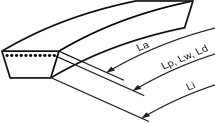
Classification of V-belts according to production technology
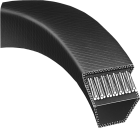
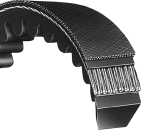
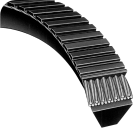
Wrapped belts Cut belts PU 60° belts
Wrapped belts
In the early days of V-belt production, only coated belts were produced.
Wrapped because the tensile structure is completely wrapped with a cover fabric
and vulcanised with rubber. Thus, the tensioning thread is not visible in coated belts.
According to DIN classic profile: 6, 8/T, 10/Z, 13/A, 17/B, 20, 22/C, 25, 32/D, 38, 40/E
DIN narrow profile: SPZ, SPA, SPB, SPC
According to RMA classic profile: 3L, 4L, 5L
According to RMA narrow profile: 3V, 5V, 8V
Cut belts
Cut belts are a newer design. They are manufactured in the same widths as the
coated belts and can also be used on identical pulleys. The belts are
are manufactured in a sleeve which is additionally cut into belts. The sides of the belts are
subsequently ground. In the case of cut belts, the construction is visible on the sides
of tensile fibres and most of them have bottom teeth (not a requirement).
According to DIN classic profile: X5, X6, X8, ZX, AX, BX, X20, CX
DIN narrow profile: XPZ, XPA, XPB, XPC
RMA narrow profile: 3VX, 5VX
Compared to coated belts, 20 % longer service life
Compared to coated belts, 60 % increase in power transmission
Minimum length variation of belt stretch under load
Gearing allows the use of smaller diameter pulleys
PU 60° belts
Used in compact high-speed machines with large circumference
speeds. They are resistant to fatigue and wear. The 60° side angle ensures good
tension distribution. Top ribbing holds the belt in the pulleys and prevents over-rotation.
Profile: 3M PUR, 5M PUR, 7M PUR, 11M PUR
Difference between classic and narrow profile
Narrow profiles are produced in both wrapped and cut versions, as more powerful
replacement for the most commonly used conventional profiles. The narrow profile belts will transfer
50-100% more power than conventional profile belts.
Example for a 13 mm wide belt:
The classic A/13 wrapped profile can be replaced by a narrow SPA wrapped profile
The classic AX cut profile can be replaced by the narrow XPA cut profile
all 4 profiles can be used on the SPA pulley
How to choose a suitable belt
While each manufacturer labels their belts with the profile name, they also label them
the name of the product line to differentiate their products from their competitors. However, one can
it can be said that all belts are manufactured on the same design principle. Belts
are fitted with tensile fibres at the calculated height, which are vulcanised
in the rubber body of the belt.
The differences in the quality of belts of different brands are mainly due to the type, quality
and density of the tensile fibre distribution, the structure (one or more layers of fibre)
and the quality of vulcanisation. For coated belts, the quality and number of
layers of the fabric wrapping.
Therefore, select the belt according to the width of the profile and then according to the size information.
of the power to be transmitted. Nowadays, when many manufacturers are moving production to
China and then brand their products with their logo and markings, e.g. standard, clasic
etc., choose also according to your experience or the references of others.
PES - polyester construction
Standard design. The belts are fitted with PES at the height of the calculated length Lw
tensile fibres. Of course, the construction varies in detail from manufacturer to manufacturer
or in the composition of the rubber compound.
KEV - Kevlar construction
Most manufacturers often offer a more powerful alternative to the classic
belt with PES fibre in the form of belts with KEV (Kevlar, Aramid) fibre.
These belts have the same construction as PES belts. However, due to the fibre used
they transmit up to twice the power, are more resistant to shocks and are more expensive. Kevlar
belts are used for extremely demanding drives, e.g. agricultural machinery
and combine harvesters.
You can read more on our blog >>
Replacement of profiles with the same width
When replacing worn drive belts with new belts, a situation may occur that
it may be necessary to replace the original belt profile with another profile of the same width.
This is possible if the identical width is maintained. On one type of pulley of a given width
it is possible to run wrapped, cut, narrow and conventional profiles of the same width.
Of course, it is always preferable to substitute the less powerful profile when substituting
with a more powerful one. If more than one belt in a set is changed, the entire set must be replaced.
Example of changing 4 profiles that are designed for operation on the SPB pulley:
| Profile |
Transmitted power |
Power ratio |
| B |
2,47 kW |
100% |
| BX |
4,82 kW |
195 % |
| SPB |
4,55 kW |
184 % |
| XPB |
7,17 kW |
290 % |
Source: the Rubena power transfer table.
Operating data: 1200 rpm, pulley diameter 140 mm, gear ratio 1:1
Circumferential lengths Li, Lw, La
An integral part of the belt designation is its length, which is actually the circumference of the belt.
Length Lw - computational
The calculated length indicates the circumference of the belt at the neutral height of its tensile fibres.
It is the key length used in drive calculations or profile changes.
Length Li - inner
The inner length is traditionally used as an additional length for marking belts
of the classical wrapped profile T, Z, A, B, C, D, E. The Li length is also used to indicate
inch lengths of the classic profile. For example: A40" = 13x1016 Li (= A1046 Lw).
Length La - outer
The outer length is traditionally used as an additional length for marking belts
narrow wrapped SPZ, SPA, SPB, SPC or AVX auto-moto profiles.
There is a fixed length difference between the lengths Lw, La and Li for each profile, without
regardless of the length of the belt. For example, for profile 13/A the difference is: Li + 30 = Lw, Lw + 20 = La.